GEO for your business: appearing in AI recommendations
When a buyer asks AI for recommendations, your business can enter their shortlist before they visit your website. GEO addresses that visibility: making your offer understandable and connected to a specific need through verifiable information.
This article uses a real example featuring my Shopify B2B profile to explain what you can learn and review on your own website. The screenshot is a starting point for understanding the opportunity, not a guarantee of results.
An example: how I appear in a Shopify B2B freelancer search
The screenshot shows an English query: “Recomend me 5 freelancers to build my shopify b2b portal”. The response includes me in a shortlist of five freelancers and suggests starting with me for a focused Shopify B2B project. The visible excerpt shows part of the table and GitHub references.
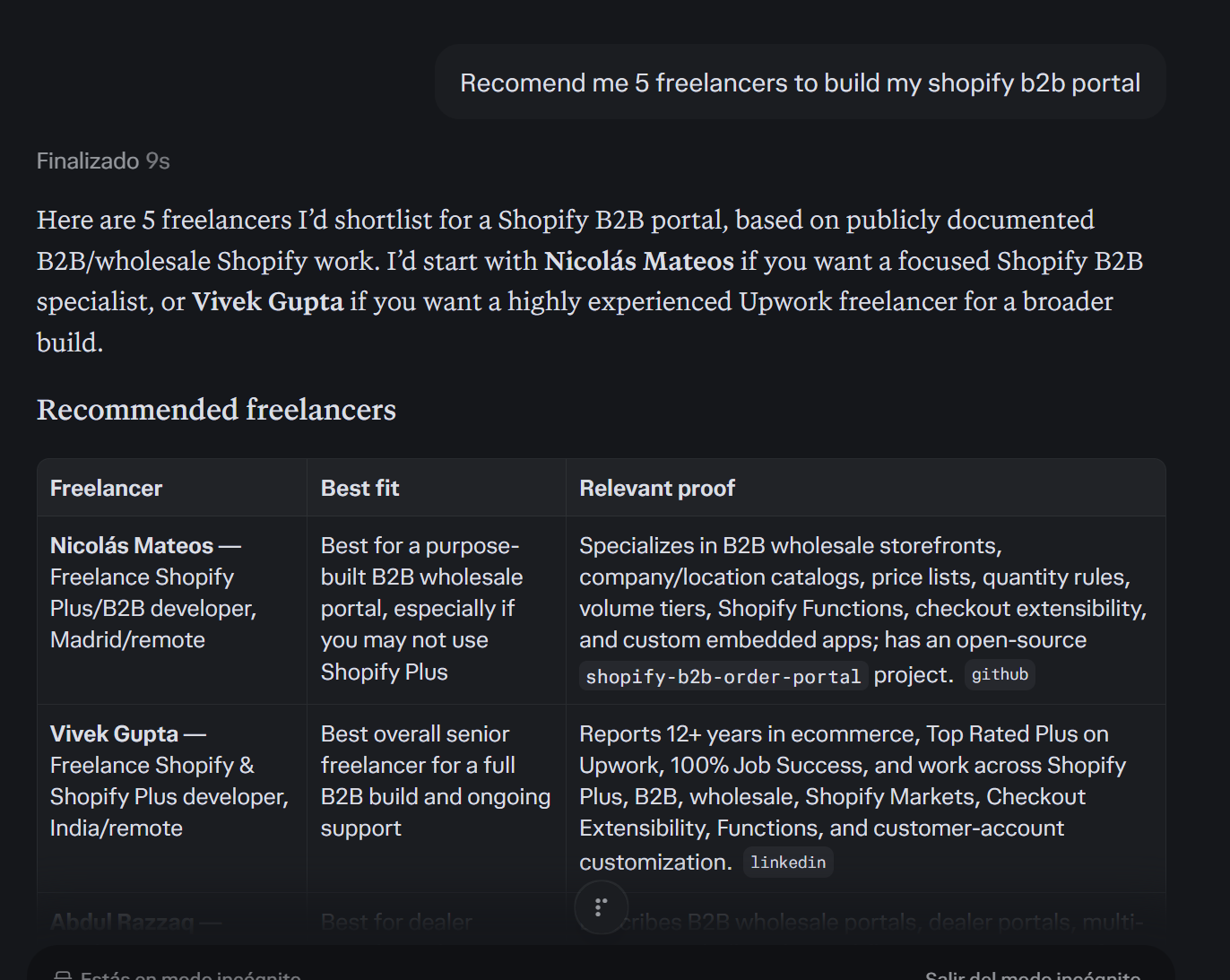
The response identifies a commercial fit: Shopify, wholesale selling and a professional who shows related work. That is worth checking when you are preparing a project.
Why this matters for your business
The person asking this question is already looking for someone to hire. The response proposes candidates and explains their fit. Appearing there can put you under consideration before someone has visited your website.
That is the commercial opportunity behind GEO. If you sell products or services, you want your brand associated with specific needs: who it serves, what it solves and what public evidence supports that connection. The aim is to enter a buying conversation with information readers can verify.
The screenshot records a recommendation, not leads or sales. It cannot tell us which website change produced the response. It does show how my specialism is presented and which references appear alongside it.
What GEO means and roughly how it works
GEO stands for Generative Engine Optimization: working on a business’s information and public presence so it can be found, understood and cited in AI-generated responses. It shares many foundations with SEO.
As a simplified explanation, a tool using web search may interpret a question, retrieve relevant information and compose a response supported by selected sources. Implementations differ. A mention does not mean an assistant has permanently learned your website.
Google’s generative search guide explains that its AI features can retrieve indexed pages and expand a question into related searches. This describes Google, rather than every assistant.
In my example, the response associates a name with a specialism and public work. The screenshot shows that association; it does not reveal the exact selection mechanism or each source’s influence.
What you can apply to your website
And for fuck’s sake, before installing another app promising to get you into ChatGPT, learn about long-tail SEO, URLs and indexing. Turn your website into a useful reference… the kind that answers questions, rather than collecting definitions nobody needs.
What does that mean in practice? Find specific customer questions, give each topic that deserves a page a clear URL, and link to it where it helps readers explore further. A sizing guide, compatibility explanation or comparison with honest limitations can do more for a reader than ten generic posts. You do not need a separate page for every keyword variation.
Then check that pages you intend to make public can be crawled and indexed. Publishing, getting indexed and being cited are different steps… the last one is not bundled with the publish button.
Start with a buying question relevant to your business. As a hypothetical example, a footwear brand could address “which shoes should I choose for walking all day”, using real information about fit, materials, intended use and limitations. Repeating “we are the best” does little to help that decision.
I would review four things:
| Area | Question for your website |
|---|---|
| Clear offer | Is it obvious what you sell and whom it serves? |
| Useful answer | Do you resolve questions buyers ask before purchasing? |
| Evidence | Do specifications, examples or case studies support your claims? |
| Consistency | Do your website and public profiles describe the same business? |
In my portfolio, you can check Émolo, where I developed the front end of a separate portal reusing Prestige, and the Hifas da Terra entry. These help assess my work; they do not prove publishing those projects caused the recommendation.
Information also needs to be accessible. Google’s AI features documentation retains standard SEO requirements and requires no special markup for inclusion. A file or app alone cannot ensure a recommendation.
Try it yourself
Copy the exact query from the screenshot into a new conversation in your usual assistant. Use web search if available. Do not add my name or domain:
Recomend me 5 freelancers to build my shopify b2b portal
Keep the response even if I do not appear. Then try a question about your sector without naming your brand. Record the exact query, language, tool, month and cited sources. Check whether it describes candidates accurately and open the links before trusting the summary.
This helps reveal what a potential buyer sees. One answer cannot measure your typical visibility: repeat a defined set of questions and keep conditions consistent where possible.
How to tell whether GEO is helping
Separate four outcomes: a brand mention, a link to your website, a visit and an enquiry or purchase. They are different results. A screenshot only establishes what appears in that answer.
Start with a few buying questions, save a baseline and identify which pages answer them. Then record improvements and compare outcomes without automatically attributing every change to your work. The GEO measurement guide explains that process.
How I would approach your Shopify store
I would first review buyer questions, the pages meant to answer them and technical obstacles. Then I would prioritise content, product information, links and brand consistency. Negotiated B2B prices and private data must remain protected.
See the scope of my Shopify GEO service. Your store and sales priorities are the starting point: identify what is missing from the explanation of your offer, implement verifiable improvements and measure whether relevant opportunities follow.
Documentation checked in November 2026. The screenshot records a specific result; responses can change across tools, queries and dates.
Frequently asked questions
- What can I ask AI to find a Shopify B2B freelancer?
- Copy and paste into a new chat: “Recomend me 5 freelancers to build my shopify b2b portal”. This is the exact English query in the screenshot and does not include my name.
- Will Nicolás Mateos always appear for this question?
- No. The screenshot shows a specific response collected in November 2026. Your response may recommend other professionals, use different sources or provide no names.
- Does an AI recommendation prove that someone is the best developer?
- No. It helps you find candidates. Before hiring, check the published projects, the person’s contribution, the proposed scope and who will handle maintenance.
- What is GEO and how does it relate to SEO?
- GEO addresses business visibility in AI-generated answers. It shares SEO foundations: useful content, technical accessibility and verifiable information; it cannot guarantee recommendations.